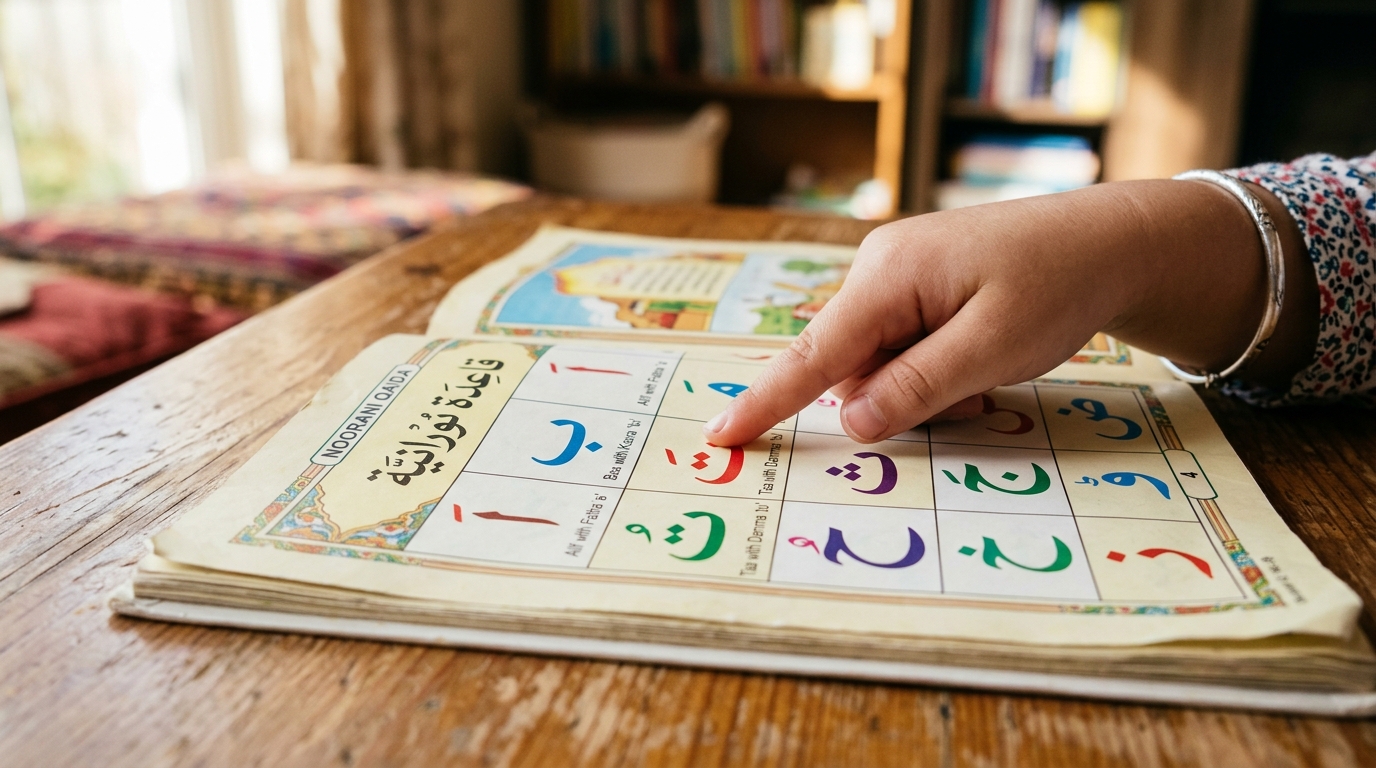
When non-Arabic speaking parents decide it is time for their child to begin reading the Holy Quran, the first book placed before them is almost invariably the famous slender booklet: Noorani Qaida. Authored by the great 19th-century Indian scholar Sheikh Noor Muhammad Haqqani, this masterwork has taught millions of children across every continent how to decode the Arabic language. But why does this specific 17-lesson sequence hold such enduring dominance, and what cognitive benefits does it unlock in the developing minds of young children?
1. Building Phonological Awareness from Single Letters to Words
Unlike Latin alphabets which are read letter-by-letter with fixed shapes, Arabic is a cursive script where letters dramatically alter their forms depending on whether they sit at the beginning, middle, or end of a word.Noorani Qaida breaks this daunting complexity into microscopic, digestible steps:
- Mufradat (Single Letters): The child first masters the 29 isolated letter sounds with pristine Makharij articulation points.
- Murakkabat (Compound Forms): Next, the child learns visual letter identification when characters are joined (e.g., recognizing Ba, Ta, Tha in ligature forms).
- Harakat & Tanween (Vowels): Short vowels (Fatha, Kasra, Damma) and double vowels are introduced with rhythmic phonetic exercises.
2. Preventing the Formation of Permanent Accidental Speech Defects
If a child is rushed directly into reading the Mushaf without a thorough grounding in Noorani Qaida, they inevitably substitute English sounds for Arabic phonetics. They will pronounce:Common Phonetic Pitfalls Noorani Qaida Eliminates
- Replacing the deep throat letter ح (Haa) with the soft English هـ (ha).
- Replacing the emphatic ط (Taa) with the flat English ت (ta).
- Confusing the unique Arabic lingual letter ض (Dhad) with a simple د (Dal).
3. The Confidence Multiplier for Young Learners
Nothing destroys a child's enthusiasm faster than opening a dense Quranic page with thousands of complex words and feeling hopelessly lost. Noorani Qaida is structured as a psychological ladder where every lesson completed is a tangible, celebrated victory.By the time a child reaches Chapter 17, they have decoded every conceivable vowel, consonant, and pause combination. Opening the Holy Quran for the first time feels like a natural step forward, not a frightening leap.
The 17 Sequential Milestones of the Noorani Qaida Curriculum
The pedagogical brilliance of Noorani Qaida lies in its strict cumulative structure. Each lesson introduces exactly one new phonetic concept while reinforcing previous knowledge:- Lesson 1: Individual Letters (Huroof Mufradat): Mastering all 29 Arabic consonants with accurate Makharij.
- Lesson 2: Compound Letters (Huroof Murakkabat): Recognizing letters in beginning, middle, and end shapes.
- Lesson 3: The Disjointed Letters (Huroof Muqatta'at): Reciting mystical opening letters like Alif-Lam-Meem with 6-count Madd elongation.
- Lessons 4–6: The Short Vowels (Harakaat) & Tanween: Pronouncing Fatha, Kasra, Damma, and double vowels without stretching.
- Lessons 7–9: Standing Vowels & Letters of Maddah: Differentiating between short and elongated vowel sounds.
- Lessons 10–13: The Silent Sign (Sukoon / Jazm) & Qalqalah: Connecting syllables with resting letters and rhythmic bouncing echoes.
- Lessons 14–17: The Doubled Sign (Tashdeed) & Advanced Rules: Mastering doubled consonants, Ghunnah nasalization, and stopping rules (Waqf).
Why Skipping Qaida Causes Permanent Reading Defects
When parents rush young children directly into reading the Holy Quran without mastering Noorani Qaida, the child invariably resorts to guessing words based on visual memory rather than decoding phonetic symbols.This premature leap creates three chronic reading defects:
- Stammering over Connected Words: The child cannot smoothly transition between letters with Sukoon and Tashdeed.
- Vowel Distortion (Imalah): English-speaking children unintentionally pronounce Arabic Fatha like a flat English 'A' (as in 'cat') rather than a pure open Arabic vowel.
- Corrupted Meanings: Confusing light letters with heavy letters changes sacred meanings (e.g. confusing Qalb [heart] with Kalb [dog]).
Frequently Asked Questions
Q: What is the ideal age for a child to start Noorani Qaida?
A: Ages 4 to 6 are optimal. At this stage, vocal cords are flexible and young minds absorb new phonetic sounds with native-like accuracy.
Q: How long does it take a child to finish Noorani Qaida?
A: With 3 to 4 classes per week, most young children comfortably master the entire Qaida within 4 to 6 months without academic stress.
Q: Can my child learn Noorani Qaida online effectively?
A: Yes! Our 1-on-1 interactive digital slides, virtual pointers, and patient male and female teachers make online Noorani Qaida classes highly engaging.
Q: What is the best age for a child to start Noorani Qaida?
A: Children as young as 4.5 to 5 years old can start Noorani Qaida. At this age, speech centers are exceptionally flexible, allowing native-like pronunciation of Arabic sounds before English accents solidify.
Q: How long does a child typically take to complete the entire Noorani Qaida booklet?
A: With consistent 1-on-1 classes 3 to 4 days per week (30 minutes per class), average students complete Noorani Qaida in 4 to 6 months, while older children often finish in 2 to 3 months.
Jamia Quran Academy Scholarly Council
Authored and reviewed by certified Islamic educators and Ijazah-bearing Qaris at Jamia Quran Academy. Committed to spreading pure Quranic literacy, Tajweed, and character-building worldwide.
Begin Your Quranic Journey Today
Experience authentic 1-on-1 online classes tailored for children and adults. Start with 3 days of completely free evaluation sessions with our certified tutors.