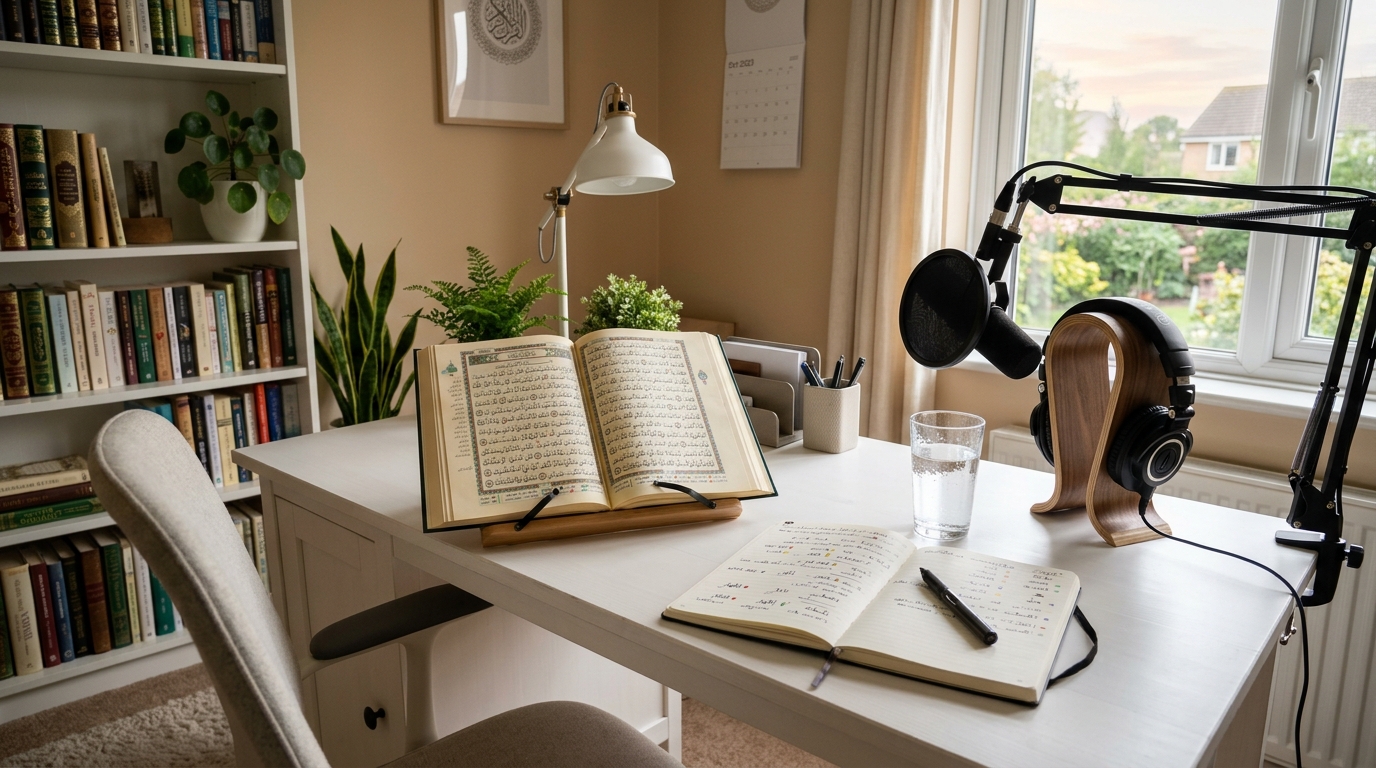
Many Muslims assume that learning to recite the Holy Quran with authentic Tajweed requires moving to Cairo, enrolling in an overseas boarding madrasah, or spending hours commuting to distant mosques. While dedicated immersion is noble, the modern reality is that you can achieve pristine recitation right from your home office or living room. With the right deliberate practice framework, mirror drills, audio self-analysis, and expert live 1-on-1 tutoring, learning Tajweed at home has never been more accessible.
Step 1: Set Up an Acoustic Home Learning Sanctuary
Tajweed is an acoustic and phonetic science. If you attempt to practice in a loud living room with children playing or a television running, your ear cannot distinguish between a clear Qalqalah echo and an abrupt stop.Choose a quiet room, invest in a quality headset with a noise-canceling microphone, and place your Mushaf at eye level on a stand to maintain proper posture and lung capacity.
Step 2: Use the 'Mirror Technique' for Difficult Makharij
The physical articulation of heavy (Mufakhkham) and light (Muraqqaq) letters requires specific tongue positioning and lip shapes:The Mirror Drill for Emphatic Letters
When practicing letters like ص (Sad), ض (Dhad), ط (Taa), and ظ (Zhaa), hold a small mirror in front of your face. Ensure that your lips do NOT round into an 'O' shape (a common English mistake), but rather the back of your tongue elevates to trap acoustic resonance inside the mouth cavity.
Step 3: The 3-Step Recording Feedback Loop
One of the fastest ways to accelerate your Tajweed progress at home:- 1. Listen to a Master Reciter: Play an Ayah by Sheikh Mahmoud Khalil Al-Husary or Sheikh Minshawi 3 times.
- 2. Record Yourself: Use your phone's voice memo app to record yourself reciting the exact same Ayah.
- 3. Compare Audio: Play both recordings back-to-back with headphones. You will instantly hear your timing gaps, missing Ghunnah, or breath hesitation.
Step 4: Secure Live 1-on-1 Guidance with a Certified Scholar
Self-drills can take you 40% of the way, but they cannot replace a scholar's trained ear. Enrolling in our Online Quran with Tajweed Course pairs you with certified teachers who identify subtle errors you are completely blind to.Step 7: Design Your Dedicated 'Home Quran Sanctuary'
Environmental psychology proves that physical surroundings profoundly influence focus and spiritual reverence. Practicing Quran on a messy bed or beside an active television breeds distraction and sluggish recitation.How to Set Up a Dedicated Quran Study Nook
- Designate a Fixed Sacred Space: Choose a quiet, well-ventilated corner of your bedroom or study facing the Qibla.
- Invest in a Wooden Rehal (Book Stand): Never place the Holy Quran flat on the floor or near your feet. An elevated wooden stand maintains proper physical posture and deep spiritual Adab.
- Use Color-Coded Tajweed Mushafs: Standardized Tajweed Mushafs use intuitive color codes (red for Madd extensions, green for Ghunnah nasalization, blue for Qalqalah echoes, and grey for silent letters), accelerating visual recognition.
- Eliminate Digital Notifications: Put smartphones on airplane mode or keep them in another room during practice time.
Step 8: The 'Record & Playback Self-Audit' Technique
The single most powerful self-study tool available to modern students is the voice recorder on their smartphone:Human beings hear their own voice through bone conduction, which often masks subtle pronunciation errors. When you record yourself reciting a half-page of Quran and play it back through over-ear headphones while following the text, mistakes in vowel duration, missed Ghunnah, or rushed Waqf (stopping signs) become instantly obvious.
"Beautify the Quran with your voices, for a beautiful voice increases the Quran in beauty!"
— Prophet Muhammad ﷺ (Sunan Abi Dawud 1468, Sunan an-Nasa'i 1015)Frequently Asked Questions
Q: How many minutes a day should I practice Tajweed at home?
A: 15 to 20 minutes of daily deliberate practice produces significantly faster results than one sporadic 2-hour session per week.
Q: Which reciter is best for Tajweed students to imitate?
A: Sheikh Mahmoud Khalil Al-Husary (Murattal pace) is universally considered by scholars as the gold standard for pedagogical Tajweed modeling.
Q: Is it permissible to listen to Quran audio while doing household chores or driving?
A: Yes! While deep contemplation requires quiet focus, ambient listening during commutes or cooking saturates your mind with proper Tajweed cadences and rhythms, vastly improving your own recitation.
Q: Which Qari should beginners listen to for clear Tajweed modeling?
A: Sheikh Mahmud Khalil Al-Husary and Sheikh Muhammad Siddiq Al-Minshawi are widely considered the gold standard for learners worldwide due to their slow, pristine, and perfectly measured articulation.

Jamia Quran Academy Scholarly Council
Authored and reviewed by certified Islamic educators and Ijazah-bearing Qaris at Jamia Quran Academy. Committed to spreading pure Quranic literacy, Tajweed, and character-building worldwide.
Begin Your Quranic Journey Today
Experience authentic 1-on-1 online classes tailored for children and adults. Start with 3 days of completely free evaluation sessions with our certified tutors.