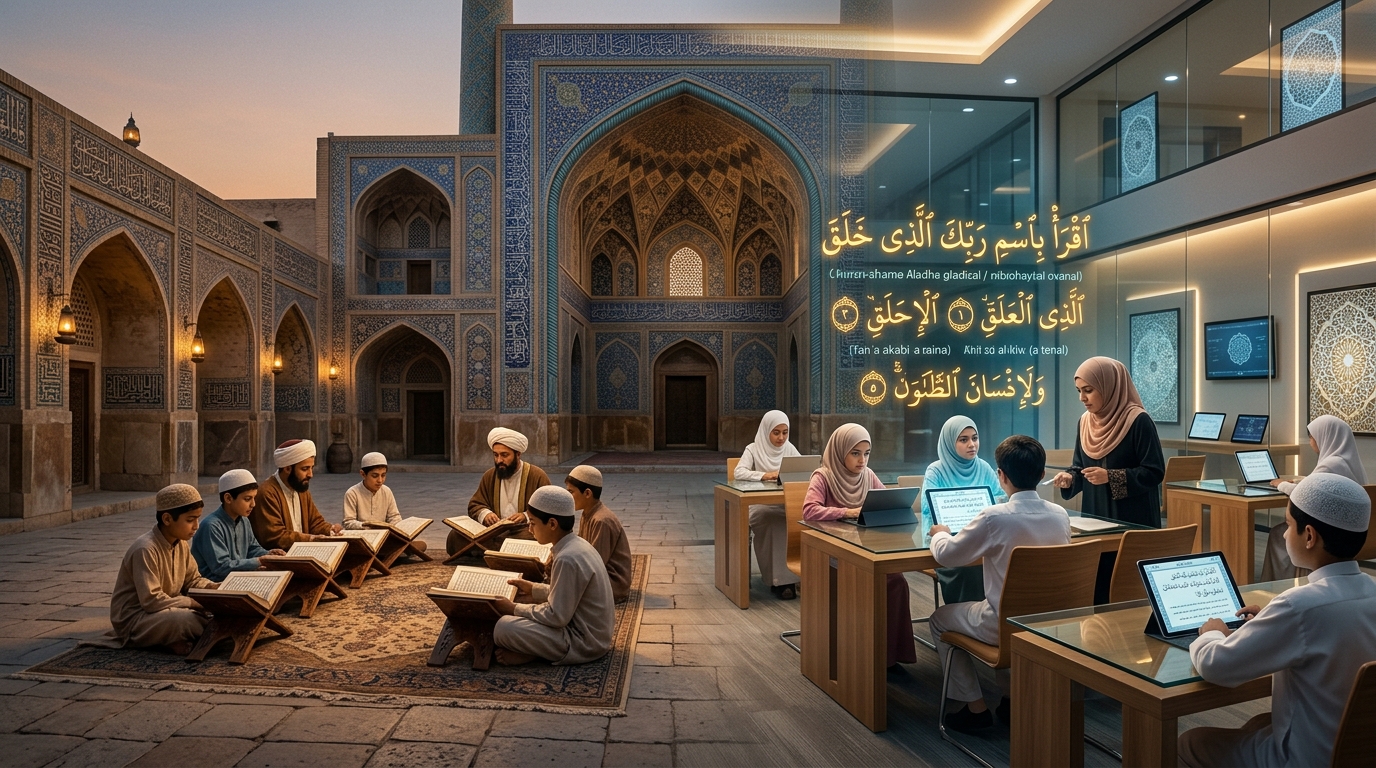
The story of Islamic civilization is fundamentally a story of educational innovation. From the humble courtyard of the Prophet's Mosque in Madinah to the sprawling marble universities of Baghdad, Cordoba, and Cairo, Muslims have always embraced the most effective technological tools of their era to preserve and disseminate sacred knowledge. Today, as fiber-optic internet and video conferencing reshape global learning, online Quran academies represent the modern continuation of this sacred pedagogical evolution.
1. Phase 1: Ashab al-Suffah & The Early Halaqat (7th Century)
The very first institutional Islamic university was Al-Suffah—a raised bench on the northern side of the Prophet's Mosque in Madinah. There, companions like Abu Hurairah RA dedicated themselves full-time to learning the Quran directly from the lips of the Messenger ﷺ.Teaching was entirely oral, personalized, and characterized by intensive repetition (Muraja'ah). This established the foundational requirement of personal transmission (Sanad).
2. Phase 2: The Classical Kuttab & Madrasah System (8th–19th Century)
As the Islamic empire expanded across continents, elementary schools known as Kuttab or Maktab were established beside mosques. Children learned Arabic literacy, memorized the Quran, and studied basic arithmetic and ethics.Major institutions like Al-Qarawiyyin in Fez (founded 859 CE) and Al-Azhar in Cairo (founded 970 CE) codified the higher sciences into structured curriculums (Dars-e-Nizami), preserving classical Arabic grammar, Hadith verification, and Tafseer methodology.
3. Phase 3: The 21st-Century Digital Revolution (Online Quran Academies)
The mass migration of Muslim families to Western nations created a severe educational dilemma: how to preserve Quranic literacy without access to traditional neighborhood Kuttabs?Modern online academies like Jamia Quran Academy represent the harmonious union of tradition and technology:
- Preserving Talaqqi: The ancient face-to-face oral transmission remains 100% intact via HD video and interactive audio.
- Global Access: Students in remote towns connect directly with certified Alimahs and Qaris halfway across the world.
- Personalization: Returning from mass classroom lectures back to the intimate, dedicated 1-on-1 mentorship modeled at Al-Suffah.
Chronological Epochs of Islamic Pedagogy: A Historical Roadmap
The pedagogical systems used to transmit Quranic sciences have evolved across 1,400 years while safeguarding textual integrity:- The Prophetic Era (Dar al-Arqam & Ashab al-Suffah): In Madinah, the shaded veranda of the Prophet's Mosque served as humanity's first residential Islamic academy, where students like Abu Hurairah (RA) dedicated their lives to oral memorization and direct teacher-to-student transmission.
- The Classical Golden Age (Kuttabs & World-First Universities): From the 8th to 14th centuries, institutions like University of Al-Qarawiyyin in Fez (founded 859 CE) and Al-Azhar in Cairo systematized Tajweed, grammar, astronomy, and jurisprudence under master scholars.
- The Colonial & Diaspora Era (Community Masjids): In the 19th and 20th centuries, Muslim immigrant communities established evening and weekend madrasahs in church basements and local mosques to preserve identity amidst foreign secular cultures.
- The 21st-Century Digital Revolution (Cloud & Global 1-on-1 Tutoring): High-speed video conferencing, interactive digital Mushafs, and cloud-based student tracking connect students in New York, London, and Sydney directly with Ijazah-bearing scholars across the Islamic world.
Preserving the Sacred 'Sanad' in the Age of Artificial Intelligence
As AI language models and digital Quran apps become ubiquitous, some wonder whether human Quran teachers will be replaced. The answer is an emphatic no.Islamic education has never been a passive download of text; it is the spiritual transfer of Nur (divine light), character modeling, and authenticated oral verification:
- Phonetic Precision Cannot Be Automated: Microscopic tongue placement (such as the lateral edge contact required for the Arabic letter Dhad) requires human acoustic assessment.
- Spiritual Adab & Mentorship: A software algorithm cannot teach humility before God, console a struggling student, or embody the living Sunnah.
- The Unbroken Chain: An Ijazah can only be conferred from human soul to human soul, preserving the living miracle of oral transmission.
Frequently Asked Questions
Q: Is online Quran education recognized by traditional Islamic scholars?
A: Yes. Leading international Islamic bodies confirm that live 1-on-1 online instruction fulfills all criteria of traditional Talaqqi, including Ijazah certification.
Q: How does digital learning protect authentic pronunciation?
A: High-definition microphones and digital whiteboards allow scholars to hear exact phonetic Makharij articulation far clearer than in crowded, noisy physical classrooms.
Q: Are online Quran classes considered as religiously valid as studying in a physical mosque?
A: Yes. Senior Islamic scholarly bodies worldwide (including Al-Azhar and Islamic Fiqh Academies) have confirmed that 1-on-1 live video instruction fulfills all traditional requirements of direct oral transmission (Talaqqi) and Musyafahah (recitation from mouth to ear).
Q: How does digital learning improve student retention compared to traditional crowded classrooms?
A: In a traditional classroom of 20 students, each child gets barely 2 to 3 minutes of personal recitation time. In our 1-on-1 online model, the student receives 100% of the teacher's undivided attention for the entire 30 to 45 minutes, multiplying progress by a factor of five.
Jamia Quran Academy Scholarly Council
Authored and reviewed by certified Islamic educators and Ijazah-bearing Qaris at Jamia Quran Academy. Committed to spreading pure Quranic literacy, Tajweed, and character-building worldwide.
Begin Your Quranic Journey Today
Experience authentic 1-on-1 online classes tailored for children and adults. Start with 3 days of completely free evaluation sessions with our certified tutors.